
Electric Vehicle Adoption as a Social Dilemma: Behavior, Technology and Public Policy
Frank Trevino Jr.
Research Paper · 2021
Harvard University
Electric Vehicles · Sustainable Transportation · Behavioral Change · Public Policy · Technology Adoption
Abstract
The transition from internal combustion engine (ICE) vehicles to electric vehicles (EVs) is not solely a technological challenge. It is also a behavioral and policy problem shaped by individual preferences, collective action, infrastructure, economic incentives, and institutional coordination. This research examines electric vehicle adoption as a social dilemma, using a game-theoretic framework to explore how individual and collective decisions influence the transition toward lower-emission transportation.
The analysis considers four possible outcomes—win-win, free-rider, sucker, and tragedy of the commons—to examine the benefits, costs, and behavioral dynamics associated with choosing an electric vehicle or retaining an internal combustion engine vehicle. Particular attention is given to technological barriers, consumer perceptions, social norms, charging infrastructure, financial incentives, innovation diffusion, and the respective roles of government, companies, and consumers.
The research finds that technology alone is insufficient to drive widespread electric vehicle adoption. Successful adoption depends on the interaction between technological development and behavioral change, supported by public policy, infrastructure, incentives, market innovation, and cooperation among government, industry, and consumers. The analysis demonstrates how a social-dilemma framework can help explain barriers to collective adoption and identify conditions under which individual and societal incentives become better aligned with improved environmental outcomes.
Research Question
How do individual behavior, collective action, technology, and public policy interact to influence electric vehicle adoption and the transition away from internal combustion engine vehicles?
Key Themes
Electric Vehicle Adoption
The transition from internal combustion engine vehicles to electric vehicles involves technological, economic, behavioral, social, and institutional factors that influence whether consumers adopt alternative transportation technologies.
Behavioral Change
Consumer preferences, attitudes, lifestyles, social norms, perceived risks, environmental attitudes, and previous experiences can influence adoption independently of technological capability.
Social Dilemmas and Game Theory
A game-theoretic framework illustrates how individual and collective choices can produce different environmental and economic outcomes depending on whether individuals and society cooperate in the transition toward electric vehicles.
Technology and Infrastructure
Battery performance, vehicle cost, charging infrastructure, recharging time, technological development, and innovation diffusion affect the feasibility and attractiveness of electric vehicle adoption.
Public Policy
Financial incentives, subsidies, infrastructure investment, regulation, education, and other government interventions can influence the costs and benefits associated with electric vehicle adoption.
Multi-Sector Coordination
Widespread adoption requires interaction among government, companies, and consumers. The effectiveness of technological and policy interventions depends on cooperation and coordination among these sectors.
Research
Introduction
Transportation continues to rely on fossil fuels as its main energy source, thus also serving as the primary contributor to air pollution and greenhouse gas emissions (Colvile et al. 2001; Gorhan, 2008; Grazi et al., 2008; Kristel et al., 2014). Efforts to identify an alternative to internal combustion engine (ICE) vehicles focus on electric vehicles (EV) to reduce environmental problems emerging from the road transport sector (Canals et al., 2016; Encarnação et al., 2018; Thiel et al., 2010).
ICE vehicles play a dominant role in society making it difficult to accept alternative energy- based transport technologies as society holds on to vehicles longer with its mature technology, established and accessible infrastructure, low cost and social acceptance; which creates a social dilemma to alternative technologies (Bishop et al., 2014; Canals et al., 2016; Kirsanovs et al., 2020).
As with any new technology, EV adoption is a challenge even with pro-environmental attitudes both in terms of financial and non-financial benefits. Key barriers include battery range and degradation, higher purchasing costs and limited infrastructure with long recharging time. But technology is not the only factor to consider as behavioral elements (preferences, attitudes, lifestyles and social norms) and socio-economic elements (cultural, social, political and economic barriers) come into play through a socio-technical system framework and innovation diffusion dynamics model that impact individual and social perceptions (Egbue et al., 2012; Lorenzoni et al., 2007; Mercure et al., 2014; Tran et al., 2012).
In this social dilemma analysis, the utilization of game theory is presented by formalizing a matrix with the individual versus everyone else perspectives (De Vries, 2012). By nature, the complexity of social dilemmas around game theory requires multi-level and multi-sectorial 6
responses for coordination, thus it is important to highlight the key sectors within the social dilemma and game theory to fully understand how policy impacts the benefits and costs within each dilemma payoff and opportunity. Successful EV adoption requires all three sectors (government, companies and consumers) to effectively cooperate and coordinate resulting in positive environmental quality (De Vries, 2012; Encarnação et al., 2018)
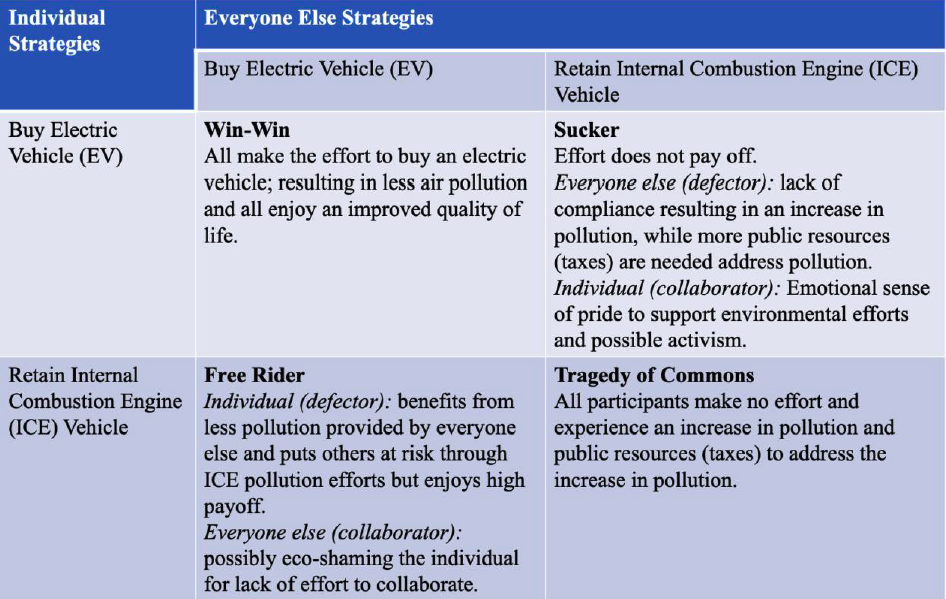
Figure 1: Social Dilemma Situation: Purchase Electric Vehicle (EV) versus Retain Internal Combustion Engine (ICE) Vehicle (De Vries, 2012)
Win-Win Quadrant
In this framework, induced cooperation and coordination around policy allow the collective relationship between an individual and society (everyone) to create positive decision-making payoffs (De Vries, 2012). Three major motivators include a collective effort to decrease energy consumption, produced CO2 emissions and air pollution through electric vehicle (EV) use (Encarnação et al., 2018); next is collective change around the integration of renewable EVs to replace fossil fuels (Holland et al., 2016; Tran et al., 2012); and lastly is the need to reduce reliance on internal combustion engines (ICE) vehicles to promote environmentally friendly and clean transport (Canals et al., 2016; Caserini et al., 2013; Kirsanovs et al., 2020; Śliwa et al., 2018).
Fossil fuel consumption within the transportation sector continues to rise and serves as a primary source of air pollution and harmful environmental emissions (Colvile et al., 2001; Encarnação et al., 2018; Falahi et al., 2013; Thiel et al., 2010). For example, OECD (1988) briefly considers regional and global impacts of transport emissions of air pollution but is mostly concerned with the impact of emissions on local urban air quality and considers only road transport. EVs are a major option as a less polluting energy-based transport technology to reduce environmental problems emerging from the road transport sector (Encarnação et al., 2018; Viola, 2021; Zhang et al., 2014).
The market for EVs is reviving with short-term and long-term benefits such as reduced environmental impacts, innovation spillovers and reduced reliance on imported oil (Holland et al., 2016). In contrast, older ICE vehicles tend to emit more air pollution (Canals et al., 2016; Caserini et al., 2013; Encarnação et al., 2018). Higher air pollution levels from 2013 fleet models resulted in 17-29% higher carbon monoxide and 9-14% higher hydrocarbons (Bishop et al., 2014).
For consumers, evidence supports both energy and money saving benefits around EVs. It was determined that a new EV’s usage cost 27.8 % less than a new diesel car and 30 % less than a new gasoline car. A 5-year-old EV will cost 22.3 % less than a 5-year-old diesel and 19.2 % less than a 5-year-old gasoline car (Kirsanovs et al., 2020). Efforts to promote large scale adoption among producers/sellers are evident by U.S. policymakers through programs such as The American Recovery and Reinvestment Act 2009 providing over $2 billion for electric vehicle and battery technologies (Egbue et al., 2012). In addition, policies, such as financial incentives, technology support and charging infrastructure will drive adoption (Zhang et al., 2014). For example, one method to make EVs marketable is to offer incentives or financing to consumers by the government or private companies (Falahi et al., 2013).
Key to this collective adoption is innovation diffusion and a socio-technical system influenced by behavioral and technology factors that lead to mass EV adoption. Individuals and groups learn of innovation from previous adopters that positively influence further adoption and accelerate diffusion and take into consideration technology, culture, social, political and economic barriers (Egbue et al., 2012; Mercure et al., 2014; Tran et al., 2012). Technology is not enough to encourage change; behavioral change stands out as a critical factor to face the challenges of reducing energy consumption and emissions. It is essential to educate people not only to choose more efficient vehicles but also change the way they use them (Rolim et al., 2012). These efforts address pro-environmental attitude versus pro-environmental behavior when it comes to perceptions to reduce the behavioral gap around environmental consumerism, which when done properly lead to social cooperation and adoption. When all sectors cooperate and coordinate on multi-levels, benefits of environmental quality outweigh costs (Encarnação et al., 2018).
Free-Rider Quadrant
In this framework, the individual (defector) enjoys the high payoff from everyone else collaborating to own an EV to reduce air pollution, while this individual is still driving an ICE vehicle. Yet in this policy dilemma, if enough free-rider individuals enjoy the benefits from an EV driven environment with no effort, then over time, this payoff would lose value or lose its goal, in this case, reduced pollution that benefits everyone. Along with this dilemma, the individual also increases the risk of eco-shaming by everyone else for a lack of collaborating (De Vries, 2012).
Individuals face a number of obstacles when it comes to EV adoption. 1) battery range and degradation, 2) higher purchasing costs, 3) limited charging infrastructure and long recharging time, 4) perceived risks, 5) running costs, and 6) the evolution of technology (Encarnação et al., 2018). Yet, deeper issues related to individual and social perceptions include lack of knowledge, uncertainty and skepticism, reluctance to change lifestyles, personal control issues and social norms and expectations. This range of influences include past behavior, experiences, feelings, social networks, institutional trust, demographic background and attitudes and behavior toward environmental issues (Encarnação et al., 2018). For example, during Covid 19, a large number of individuals choose not to wear masks for a number of reasons, 1) medical, 2) how it makes them feel, 3) distorting of science, 4) personal freedom and 5) government conspiracy (Capraro et al., 2020). These individual and social perceptions must be addressed to achieve adoption. To address these challenges around EV adoption, especially individual or social perceptions, research shows that advertising on environmental benefits of green products can be relevant in changing behaviors (Nyborg et al., 2006) and contribute to bridging the gap between consumers intents/concerns and actions (Kalamas et al., 2014). Yet, it is not enough for people to know about climate change in order to be engaged; they also need to care about it, be motivated and able to take action (Lorenzoni et al., 2007).
While there are a number of challenges around EV adoption for individuals, they easily fall into the social trap of eco shaming for serving as a defector. Mainly used as a proven strategy for combatting climate change against corporations (Taebi et al., 2017). Shaming in now utilized against individuals who speak against climate change or lack interest in climate change all together, similar to how mask shaming takes place today around Covid 19 (Thelen, 2019).
While the impact of the free rider may be limited initially, the lack of future cooperation and coordination to address consumer needs could lead to a transitioning to the Sucker Quadrant over time (Encarnação et al., 2018).
Sucker Quadrant
In this framework, the individual (collaborator) purchases an EV in their effort to reduce air pollution, while everyone else (defectors) lack of compliance to transition to EVs fail to help achieve environmental quality. This lack of collaboration by society leads to an increase in air pollution, CO2 emissions and energy consumption, which initiate public policy reform, increase in funding (taxes) to combat environmental change and review for an alternative transportation energy solution for its failing efforts to increase EV mass adoption (De Vries, 2012). This leads to reviews around its innovation diffusion and socio-technical system to determine if change is viable (Egbue et al., 2012; Mercure et al., 2014; Tran et al., 2012). One positive is the individual feels an emotional sense of pride for supporting sustainability efforts and may also participate in activism against defectors (De Vries, 2012).
As highlighted in the previous Free-Rider Quadrant, the same obstacles that individuals face are the same obstacles that society faces as well (Encarnação et al., 2018). Despite potential advantages for EVs, significant barriers remain thus limiting widespread adoption of EV technology. While battery technology limitations, high battery cost and limited charging infrastructure are major obstacles to widespread adoption, society’s resistance to EVs surround its socio-technical system (technological, cultural, social, political and economic barriers). Acceptance is crucial to adoption in the sustainable transportation sector. Manufacturers and policy makers must identify and overcome consumer issues, or they will continue to face low acceptance of EVs long after technical issues are resolved (Egbue et al., 2012). The general public’s perception of risk is based on experience, emotions, the media and other non-technical sources (Sjoberg, 1999). More importantly is understanding what influences a consumer’s decision. Research found that social preferences for environmental quality were a major determinant for adoption and that social preferences increased EV sales more than rising gas prices or tax incentives (Gallagher et al., 2011). The adoption of this technology follows the same principles of multi-sectorial frequency dependence, exploration and peer-influence around government subsidies, shared infrastructure costs, technology investment or environmental activism are mechanisms who implementation depends on the engagement of particular sectors (Encarnação et al., 2018).
While the term sucker denotes a gullible or easily deceived person, it should be stated that the individual who collaborated to purchase the EV also incorporates a number of socio-technical reasons to owning the EV, including energy and money saving benefits (Kirsanov et al., 2020), as well as attitudes influencing the transition from a conventional ICE to EV by embracing a future vision point of view or saving our planet mindset (Viola, 2021).
Tragedy of Commons Quadrant
In this framework, there is a negative collaboration between the individual and society, as both make no effort to transition to EVs and stay within the dominant status quo of ICE vehicles. All efforts around policy surrounding the reduction in air pollution and the reduction of ICE vehicles fail. This failure also impacts the innovation diffusion and socio-technical system to influence adoption on a mass level (Egbue et al., 2012; Mercure et al., 2014; Tran et al., 2012). As a result, more resources from government are needed to address air pollution through financial incentive and policy reforms, while reviewing alternative transportation energy solutions to possibly substitute ICE vehicles.
This collaborative relationship reinforces a negative mindset regarding the six obstacles outlined in the Win-Win Quadrant around technology, but also the individual and social perceptions regarding environmental perspectives (Encarnação et al., 2018). In this situation, a behavioral gap is created in environmental consumerism that translates into a continuous mismatch of environmental attitudes and their engagement in environmental attitudes (Zhang et al., 2014). The combination of technological and social barriers leads to a tragedy of commons type scenario in which environmental quality (public good), built upon social cooperation through EVs, is endangered by the temptation to free ride on a mass level. This complex social dilemma requires multi-level and multi-sectorial coordination inputs to avoid the non-cooperative state but as individuals discount the future of EV technology, this also plays into society as a whole as the perception that EVs are not the solution to reduce air pollution. (Encarnação et al., 2018). For example, in the early 2000s, natural gas vehicles (NGV) in Germany failed to adopt due to a number of challenges. 1) rising fuel prices and tax incentives are not sufficient to induce consumer adoption, 2) lack of participation among market players led to higher risk, 3) failure of competition to drive engagement and 4) lack of knowledge (Von Rosentiel et al., 2015).
While government and private companies could offer additional financial incentives (tax subsidies, grants) or educational awareness (Falahi et al., 2013; Romlin et al., 2012), it is at this point that all sectors should evaluate other viable transportation energy alternatives in line with consumer demand and supplier capabilities (Von Rosentiel et al., 2015). In this case, costs outweigh the public good benefit of environmental quality.
Conclusion
The transition path to EVs and improved environmental quality is challenging with the dominant ICE vehicle making alternative renewable energy adoption difficult. While complex, the social dilemma offers insight to various quadrants under different circumstances to understand the payoff, benefits and cost around EV adoption (De Vries, 2012). By applying a game theory approach, different scenarios play out to understand the behavior of why an individual collaborates versus society defects or vis-versa and what efforts are needed to look beyond the dilemma. This impact is important to understand the policy role of government in relation to companies and consumers around its multi-level and multi-sectorial cooperation and coordination to massively adopt EVs, but more importantly to improve environmental quality (De Vries, 2012; Encarnação et al., 2018).
Social dilemma situations vary within each quadrant but the key to adoption is understanding behaviors and technology. Companies need to understand consumer behaviors (financial and non-financial motivation) and consumers need to understand company technology capabilities around EV, but the role of government serves as the foundation between all sectors. Government not only directs policy but also provides financial resources through grants, subsidies (green tax), and incentives to jump start and lead EV adoption. Public driven cooperation and coordination is required to drive EV adoption and to fulfill its goal around environmental quality (Egbue et al., 2012; Encarnação et al., 2018; Gallagher et al., 2011; Iyer et al., 2014).
References
Bishop, Gary A, & Stedman, Donald H. (2014). The Recession of 2008 and Its Impact on Light-Duty Vehicle Emissions in Three Western United States Cities. Environmental Science & Technology, 48(24), 14822-14827.
Canals Casals, Lluc, Martinez-Laserna, Egoitz, Amante García, Beatriz, & Nieto, Nerea. (2016). Sustainability analysis of the electric vehicle use in Europe for CO2 emissions reduction. Journal of Cleaner Production, 127, 425-437.
Capraro, V., & Barcelo, H. (2020, May 11). The effect of messaging and gender on intentions to wear a face covering to slow down COVID-19 transmission. https://doi.org/10.31234/osf.io/tg7vz
Caserini, Stefano, Pastorello, Cinzia, Gaifami, Pietro, & Ntziachristos, Leonidas. (2013). Impact of the dropping activity with vehicle age on air pollutant emissions. Atmospheric Pollution Research, 4(3), 282-289.
Colvile, R.N, Hutchinson, E.J, Mindell, J.S, & Warren, R.F. (2001). The transport sector as a source of air pollution. Atmospheric Environment, 35(9), 1537-1565.
De Vries, Bert J. M. (2012). Sustainability Science. New York: Cambridge University Press.
Egbue, Ona, & Long, Suzanna. (2012). Barriers to widespread adoption of electric vehicles: An analysis of consumer attitudes and perceptions. Energy Policy, 48, 717-729.
Encarnação, Sara, Santos, Fernando P, Santos, Francisco C, Blass, Vered, Pacheco, Jorge M, & Portugali, Juval. (2018). Paths to the adoption of electric vehicles: An evolutionary game theoretical approach. Transportation Research. Part B: Methodological, 113, 24-33.
Falahi, Milad, Chou, Hung-Ming, Ehsani, Mehrdad, Xie, Le, & Butler-Purry, Karen L. (2013). Potential Power Quality Benefits of Electric Vehicles. IEEE Transactions on Sustainable Energy, 4(4), 1016-1023.
Gallagher, K.S., Muehlegger, E.J., 2011. Giving green to get green? incentives and consumer adoption of hybrid vehicle technology. Journal of Environmental Economics and Management 61 (1), 1–15.
Gorham, R., United Nations. Division for Sustainable Development, & Global Initiative on Transport Emissions. (2002). Air pollution from ground transportation: An assessment of causes, strategies and tactics, and proposed actions for the international community. New York: United Nations.
Grazi, Fabio, & Van den Bergh, Jeroen C.J.M. (2008). Spatial organization, transport, and climate change: Comparing instruments of spatial planning and policy. Ecological Economics, 67(4), 630-639.
Holland, Erin T. Mansur, Nicholas Z. Muller, & Andrew J. Yates. (2016). Are There Environmental Benefits from Driving Electric Vehicles? The Importance of Local Factors. The American Economic Review, 106(12), 3700-3729.
Iyer, Swami, Reyes, Joshua, & Killingback, Timothy. (2014). An application of evolutionary game theory to social dilemmas: The traveler’s dilemma and the minimum effort coordination game. PloS One, 9(4), E93988.
Kalamas, Maria, Cleveland, Mark, & Laroche, Michel. (2014). Pro-environmental behaviors for thee but not for me: Green giants, green Gods, and external environmental locus of control. Journal of Business Research, 67(2), 12-22.
Kirsanovs, Vladimirs, Barisa, Aiga, & Safronova, Alina. (2020). Cost-benefit assessment of electric vehicle vs internal combustion engine in Latvia. 2020 IEEE 61th International Scientific Conference on Power and Electrical Engineering of Riga Technical University (RTUCON), 1-4.
Kristel M. R. Hoen, Tarkan Tan, Jan C. Fransoo, & Geert-Jan van Houtum. (2014). Switching Transport Modes to Meet Voluntary Carbon Emission Targets. Transportation Science, 48(4), 592-608.
Lorenzoni, Irene, Nicholson-Cole, Sophie, & Whitmarsh, Lorraine. (2007). Barriers perceived to engaging with climate change among the UK public and their policy implications. Global Environmental Change, 17(3), 445-459.
Mercure, J.-F, Pollitt, H, Chewpreecha, U, Salas, P, Foley, A.M, Holden, P.B, & Edwards, N.R. (2014). The dynamics of technology diffusion and the impacts of climate policy instruments in the decarbonisation of the global electricity sector. Energy Policy, 73, 686-700.
Nyborg, Karine, Howarth, Richard B, & Brekke, Kjell Arne. (2006). Green consumers and public policy: On socially contingent moral motivation. Resource and Energy Economics, 28(4), 351-366.
Rolim, Catarina C, Gonçalves, Gonçalo N, Farias, Tiago L, & Rodrigues, Óscar. (2012). Impacts of Electric Vehicle Adoption on Driver Behavior and Environmental Performance. Procedia, Social and Behavioral Sciences, 54, 706-715.
Sjoberg, Lennart. (1999). Consequences of perceived risk: Demand for mitigation. Journal of Risk Research, 2(2), 129-149.
Śliwa, Adrian. (2018). Electric vehicle vs. internal combustion car in the smart city concept. Transport Economics and Logistics, 79, 65-76.
The cost of air pollution: Health impacts of road transport. (2014). Paris, France: OECD.
Taebi, B, & Safari, Azar. (2017). On Effectiveness and Legitimacy of ‘Shaming’ as a Strategy for Combatting Climate Change. Science and Engineering Ethics, 23(5), 1289-1306.
Thelen, Elaine, W. (n.d.). ‘Eco-shaming’: Does it work? World Economic Forum. https://www.weforum.org/agenda/2019/07/eco-shaming-is-rising-but-does-it-work/.
Thiel, Christian, Perujo, Adolfo, & Mercier, Arnaud. (2010). Cost and CO2 aspects of future vehicle options in Europe under new energy policy scenarios. Energy Policy, 38(11), 7142-7151.
Tran, Martino, Banister, David, Bishop, Justin D. K, & McCulloch, Malcolm D. (2012). Realizing the electric-vehicle revolution. Nature Climate Change, 2(5), 328-333.
Viola, Fabio. (2021). Electric Vehicles and Psychology. Sustainability (Basel, Switzerland), 13(2), 719.
Von Rosenstiel, Dirk Peters, Heuermann, Daniel F, & Hüsig, Stefan. (2015). Why has the introduction of natural gas vehicles failed in Germany? Lessons on the role of market failure in markets for alternative fuel vehicles. Energy Policy, 78, 91-101.
Zhang, Xingping, Xie, Jian, Rao, Rao, & Liang, Yanni. (2014). Policy Incentives for the Adoption of Electric Vehicles across Countries. Sustainability (Basel, Switzerland), 6(11), 8056-8078.
About This Research
Originally completed in 2021 through Harvard Extension School as part of ENVR E-101, Introduction to Sustainability and Environmental Management. This work has not been peer-reviewed.
Citation
Trevino, Frank Jr. (2021). Electric Vehicle Adoption as a Social Dilemma: Behavior, Technology, and Public Policy. Research paper, Harvard University.