
Managing the Emerald Ash Borer: A Systems Approach to Invasive Species Policy
Frank Trevino Jr.
Research Paper · 2021
Harvard University
Systems Thinking · Environmental Policy · Forest Management · Invasive Species
Abstract
Invasive forest pests present complex environmental and economic challenges that evolve as biological invasions progress from initial risk to widespread establishment. This research examines the Emerald Ash Borer (EAB) through a systems-thinking framework, using causal loop diagrams to analyze policy responses across four phases of invasive-species management: absent, localized, spreading, and pervasive.
The analysis considers how prevention, eradication, containment, detection, biological and chemical controls, international phytosanitary standards, public engagement, and resource-protection strategies interact with the ecological and economic consequences of EAB infestation. Particular attention is given to the relationship between policy interventions, ash-tree morbidity and mortality, forest biomass, institutional decision-making, and the changing distribution of costs among governments, municipalities, property owners, and other stakeholders.
The research finds that the effectiveness and economic burden of invasive-species management change substantially as an invasion progresses. Early prevention can reduce the likelihood and cost of establishment, while delayed detection and unsuccessful eradication increase the need for increasingly complex and costly interventions. The EAB case demonstrates the value of systems thinking for understanding these relationships and suggests that stronger prevention, early detection, adaptive management, scientific research, and coordinated policy can improve responses to future invasive forest pests.
Research Question
How can systems thinking and causal loop analysis help explain the effectiveness, costs, and policy trade-offs associated with managing the Emerald Ash Borer across different phases of biological invasion?
Key Themes
Systems Thinking
Causal loop diagrams provide a framework for understanding how ecological conditions, invasive-species populations, public policy, scientific knowledge, and management interventions interact over time.
Invasive Species Management
The research examines invasive-species management through four phases: absent, localized, spreading, and pervasive, demonstrating how management objectives change as an invasive pest becomes increasingly established.
Prevention and Early Detection
Phytosanitary practices, monitoring, wood-packaging standards, detection systems, and other preventative interventions can reduce the likelihood that invasive forest pests become established.
Adaptive Environmental Policy
Policy evolves as an invasion progresses—from prevention and eradication to containment, mitigation, biological control, and ultimately resource protection and adaptation.
Ecological and Economic Impact
The Emerald Ash Borer demonstrates how biological invasion can simultaneously affect forest ecosystems, municipalities, governments, homeowners, industries, and the broader economy.
Science, Technology and Data
Satellite imaging, GPS, databases, numerical analysis, biological research, chemical controls, and other technologies become increasingly important as policymakers attempt to understand and manage invasive-species spread.
Research
Causal Loop Diagram of the Emerald Ash Borer
Four Phases: Absent, Localized, Spreading and Pervasive
Invasive forest pests are continuously introduced into United States forests with the rise of international trade and travel. The main pathways are the importation of live plants and wood packing material (Lovett et al., 2016; Marché, 2017). Once detected, various methods and resources are needed to manage the impact of such pests in order to preserve ecological and economic ecosystems. This primary method is organizing nonnative pest infestation around four phases: absent, localized, spreading, and pervasive (Lovett et al., 2016). In particular, this paper will focus on the Emerald Ash Borer (EAB). It will address the four phases of the nonnative EAB insect spread by understanding policies to properly reduce its impact on the environment and economy while exploring the methodologies and costs associated at each phase.
Since its arrival to North America in the mid-1900s, the EAB has spread to 35 states and five Canadian provinces and has killed hundreds of millions of ash trees, with billions more still at risk (Flower et al., 2013; Stack et al., 2019). While total removal and replacement costs have not been properly determined nationally, early estimates for Ohio alone place these costs between $1.0 and $4.2 billion. Additional research estimates the cost of treatment, removal, and replacement due to EAB infestation over a 10-year horizon of $10.7 billion, or $1 billion per year. Assessing potential economic impact is needed to evaluate the efforts to slow down the EAB and determine the needed investments in research, EAB biology, and management (Kovacs et al., 2010).
Absent Phase
In the absent phase, the EAB has yet to be introduced into the North American forest biomass. Healthy forest biomass is critical to the impact of trees and forests within themselves, their forest productivity, wildlife, environmental cycles, and human quality of life (Brockerhoff et al., 2017). Past cases point to the need for effective absence-based programs to inhibit the arrival of invasive pests in order to maintain positive forest biomass growth in North America (Lovett et al., 2016). As part of the CLD, two key policy elements include point of origin and arrival pathways as prevention methods in this phase (Lovett et al., 2016; Marché, 2017). These two elements remain separate from the forest biomass CLD at this time but serve as their own system of prevention against EAB. Sub-element strategies within the point of origin policy include phytosanitary practices and abroad monitoring strategies. The sub-element strategy for arrival pathway policy is the wood packaging material policy (WPM).
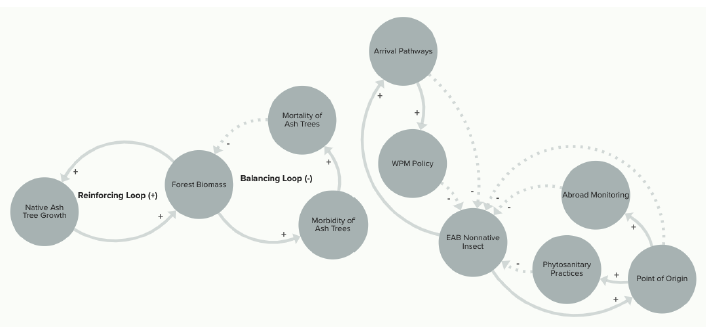
Figure 1: Absent Phase Causal Loop Diagram of Emerald Ash Borer (de Vries, 2013; Kirkwood, 1998; Lovett et al., 2016)
Phytosanitary is a pre-clearance partnership to strengthen clean supply chain practices in countries of origin, in this case China, with EAB. Abroad monitoring seeks out the identification of possible future forest insects and pathogens before entry into the U.S. Both programs provide the benefit of enforcing stringent standards for importers to meet while receiving benefits for those who comply. (Lovett et al., 2016). Also, these efforts to inhibit invasive pests and EAB in North America would positively impact the challenges stemming from wood packing material (WPM) as arrival pathways for such invasive pests by strengthening international relationships that yield favorable trade and economic conditions (Brockerhoff et al., 2017; Lovett et al., 2016). For example, a recent assessment of ISPM-15 will yield cumulative net benefits reaching $11 billion by 2050 while reducing pest imports by 36-52% (Leung et al., 2014; Lovett et al., 2016).
While these policies are aimed at creating a positive impact, globalization often causes a reactive approach when it comes to ecological policy. Globalization facilitates the spread of invasive species, and the rapid increase in U.S. international trade during the mid-1990s unfortunately led to a lack of policy development around phytosanitary practices, abroad monitoring, and WPM policy globally (Lovett et al., 2016; Marché, 2017; Meyerson et al., 2007). In the case of the EAB, this led to its own policies lacking the preventive measures created under the Plant Quarantine Act of 1912 to safeguard against nonnative invasive pests, which eventually allowed the EAB to establish itself in North America (Lovett et al., 2016; Marché, 2017).
The costs incurred during the absence phase rest mainly on its international importers and the federal government to maintain such programs (Lovett et al., 2016). But once nonnative pests are established and begin to spread, a cascade of impacts increases the costs borne by local landowners and local governments (Aukema et al., 2011).
Localized Phase
In the localized phase, EAB was first discovered around 1998 in Michigan but not identified until 2002 (Lovett et al., 2016; Marché, 2017; Haack, 2015). Upon detection, numerous agencies, including the Michigan Department of Agriculture (MDA), Animal and Plant Health Inspection Service (APHIS), and the Forest Service, were immediately notified and began enacting post-entry policies to contain and eradicate as outlined in their Integrated Pest Management (IPM) Policy (Lovett et al., 2016; Marché, 2017).
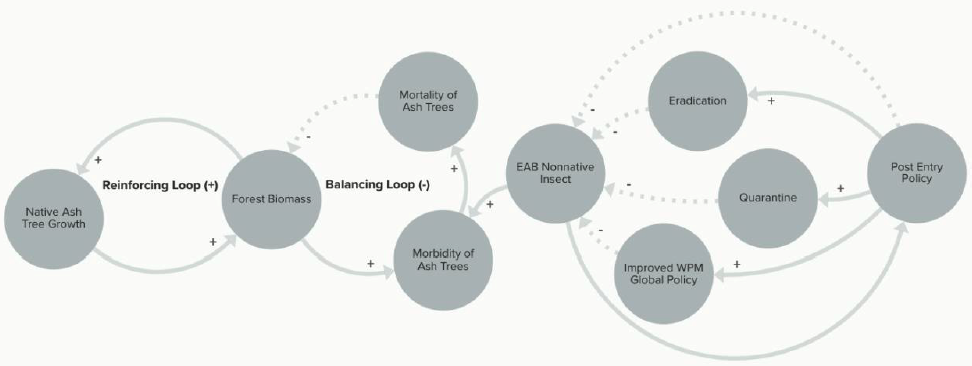
Figure 2: Localized Phase Causal Loop Diagram of Emerald Ash Borer (de Vries, 2013; Kirkwood, 1998; Lovett et al., 2016)
In this phase, EAB is now impacting the morbidity of ash trees and gained a head start because it was not identified for four years upon its arrival in the mid-1900s (Lovett et al., 2016; Marché, 2017; Duan, 2019). The effectiveness of the post-entry policy and individual sub-elements: eradication, quarantine, and improved WPM policy will determine over time the stability of the reinforcing and balancing loop and whether it can contain and eradicate EAB.
Quarantine efforts set by the MDA and APHIS centered around its “cut and chip” program and “stop the transport” of ash trees, mainly all through voluntary efforts, which were communicated through a comprehensive education and outreach program (Marché, 2017). This included public meetings, surveys, and PSAs. Regarding the WPM policy, a new series of international standards and regulations was also adopted concerning the importation of WPM at US ports of entry in 2002, known as the International Standards for Phytosanitary Measures No. 15 (ISPM15). (Haack et al., 2014; Leung et al., 2014; Marché, 2017).
An analysis of the MDA Eradication Strategy highlighted that while policies were put in place, multiple reasons led to its failure. 1) EAB head start of 4-5 years, promoting geographical expansion, 2) MDA’s inability to determine its “leading edge” boundary, 3) MDA & APHIS failure to enforce quarantine regulations, and 4) MDA’s choice of eradication vs. treatment approach, which led to growing public criticism (Marché, 2017). Another key factor contributing to failure included the lack of EAB life cycle information. Only two short articles concerning EAB biology were known to have been published in China before 2000 (Marché, 2017).
Core costs for the MDA and APHIS fiscal years 2002-2006 budget totaled $112.15 million (Marché, 2017). Additional eradication budget requests in 2006 were denied based on obsolete data and ineffective methods (Marché, 2017). By the end of 2006, five U.S. states and Ontario Province in Canada were termed infested by EAB (Herms et al., 2014; Marché, 2017).
Spreading Phase
After efforts to contain and eradicate EAB failed, it was time to implement a new management approach aimed at limiting its spread throughout the region. A new integrated strategy called Slow Ash Mortality, or SLAM, was implemented, centered on improving detection methods to better understand how to slow EAB. Prior methods resorted to resource-heavy visual inspections, which yielded limited results (Marché, 2017). The sub-elements included data collection, continued education & outreach, and chemical and biological control agents. (Marché, 2017). Similar to the localized phase, these policies would impact the EAB element, which would impact ash tree morbidity within the reinforcing and balancing loop biomass. Positive policy results would decrease the EAB spread and ash tree morbidity.
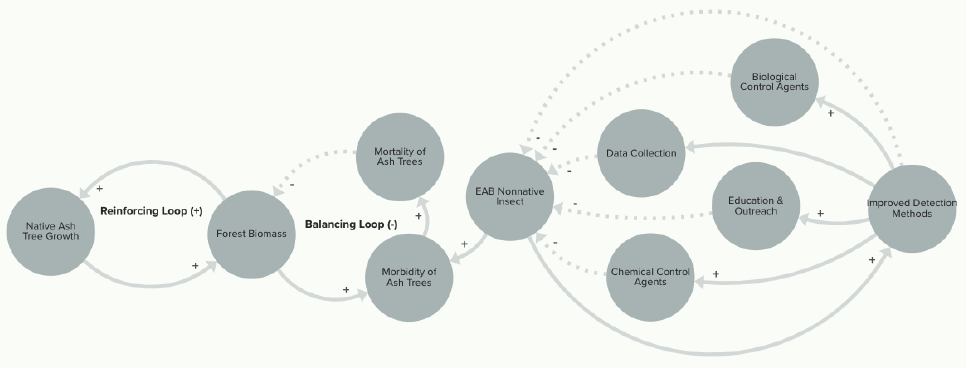
Figure 3: Spreading Phase Causal Loop Diagram of Emerald Ash Borer (de Vries, 2013; Kirkwood, 1998; Lovett et al., 2016)
As part of the learning process from previous programs, especially around criticism of its failed eradication strategy, it was prioritized to leverage data and technology to enhance its chances of slowing down EAB (Lovett et al., 2016; Marché, 2017). The use of satellite imaging, GPS, sophisticated databases, numerical analysis and digital modeling became part of its arsenal to fight the spread of EAB (Marché, 2017; Pontius et al., 2007)
Resources were also put into the continuation of its education and outreach program. It was understood that in order to slow down the EAB, it was necessary to inform all levels of government, media, and the public regarding the negative impact, both environmentally and economically, caused by EAB (Marché, 2017). Dissemination of information and news about EAB was published via a central clearinghouse website and also distributed through PR publications, training, and community partnerships. It was determined that public feedback and insight could serve as a useful method to gather and detect information with the limited number of resources available. One such opportunity included “citizen students” in Ohio, with middle school students participating in a curriculum entitled “EAB in the Classroom” that included an ash tree monitoring program, which eventually led to a peer-reviewed publication (Marché, 2017).
The program’s biggest push was around the development of chemical control agents as survey tools. As part of its efforts to understand the EAB life cycle, this was considered the next step in its research directive. The first portion included chemical lures and traps, while the second portion was devoted to the extensive testing of chemical pesticides to combat the borer. In the end, positive methods such as a proven chemical pesticide “make it economical to treat ash trees in municipalities and residential areas, rather than removing or replacing those trees,” stated Associate Professor Deborah McCullough of Michigan State University (Marché, 2017).
The final element was around the development of biological controls with a focus on natural enemies. It was immediately determined that the EAB had no natural enemies (Duan et al., 2017; Marché, 2017). Researchers visited China and surrounding Asian countries for any potential natural enemies that could possibly be introduced in North America to help combat EAB. It was found that various wasps (Spathius, Tetrastichus, and Oobius) offered a combined EAB mortality rate of more than 70% in Asia and served as a significant augmented biocontrol agent against EAB in North America. Testing in the U.S. showed potential promise (Duan et al., 2017; Marché, 2017).
The burden of costs in the spreading phase from 2007 to 2010 for the USDA-APHIS was almost $119 million for the EAB program (Marché, 2017). While efforts to reduce the spread of EAB were difficult to determine if they had been effective, from 2007 to 2010, an additional ten states, including Quebec, were added to the infestation list for a total of 15 states and two Canadian provinces (Marché, 2017).
Pervasive Phase
In the pervasive phase, as noted by Lovett (2016), it now focuses on resource protection and adaptation after all efforts to contain EAB have failed. In our CLD, the policy focuses on improving WPM policy and increasing the resistance of the ash tree to EAB, with the hopes of using proven methods to reduce EAB impact on ash tree morbidity.
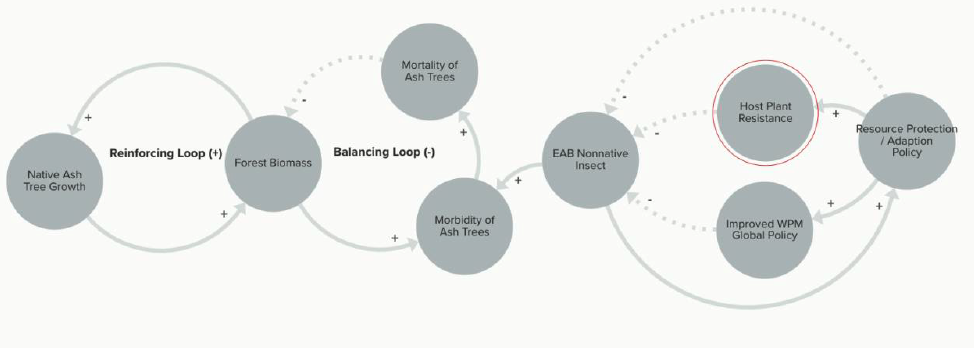
Figure 4: Pervasive Phase Causal Loop Diagram of Emerald Ash Borer (de Vries, 2013; Kirkwood, 1998; Lovett et al., 2016)
While it is quite challenging to properly determine the point of transition from the spreading phase into the pervasive phase, it could reflect the protection of the ash tree resource itself or its host plant resistance component, which, in 2011, at the USDA Interagency Research Forum on Invasive Species, was announced to be the first “putative Bt” green ash that had been regenerated (Marché, 2017; Stack et al., 2019). The objective in the pervasive phase is slowing the rate of infestation spread and maintaining as much of the forest biomass as possible (Lovett et al., 2016). It can also be noted that improvements around the WMP global policy reflect the progressive efforts to slow down the spread of EAB through continued international support. As of 2019, over 100 countries have now adopted the ISPM 15 policy. While ISPM cannot guarantee 100% effectiveness, it is still the best approach to avert the next possible invasive pest (Lovett et al., 2016; Marché, 2017).
In its efforts to move forward with its host plant resistance, additional research is still needed to continuously combat EAB through three approaches. 1) Cross-pollination of different ash species. 2) Highly analytical studies of the phloem chemistry of ash cultivars and 3) full-fledged investigations of ash tree genomics and conviction through recombinant DNA (Duan et al., 2019; Kashian et al., 2018; Marché, 2017).
USDA-APHIS budget costs associated with the pervasive stage from 2011 to 2015 were $82 million for the EAB Program (Marché, 2017). These policies continue to support efforts to slow down EAB, but an additional 20 states have now been added to the list of infested states, bringing the total to 35 states infested with EAB as of 2015 (Marché, 2017). Individual state damage losses continue to mount, with Michigan estimating median annual losses of $58 million and an overall economic toll for all states well into the billions (Kovacs et al., 2010; Marché, 2017).
Conclusions
The Emerald Ash Borer’s introduction into North America has brought devastation both environmentally and economically to ash trees and related industries in 35 U.S. states and Canada. Since its detection, many mistakes and misunderstandings around policy management, as well as a lack of life cycle research, have allowed the EAB to quickly spread across Lovett’s four-phase model. But it is this same model that provides a powerful tool to enact policy understanding to organize and analyze how limited resources are utilized. From the point of origin of WPM policy, post-entry, improved detection methods, and adaptation policies, each one plays a critical role in reducing ash tree morbidity and mortality to enhance forest biomass (Lovett et al., 2016; Marché, 2017).
An estimated 10 million ash trees have succumbed to EAB, with over $300 million in federal, state, and local funding to support efforts to battle this invasive pest since 2002, and damage losses are estimated in the billions of dollars (Kovacs et al., 2010; Marché, 2017). While previous policy efforts seem to offer more negatives to EAB containment as it continues to spread into new states, positive policy efforts include scientific progress and success in biology, ecology, and behavior research about EAB, including host tree activities, with the creation of an ash tree resistant to EAB in the near future.
References
Aukema, J. E., D. G. McCullough, B. Von Holle, A. M. Liebhold, K. Britton, and S. J. Frankel. 2010. Historical accumulation of nonindigenous forest pests in the continental United States. BioScience 60:886–897.
Aukema, J. E., et al. 2011. Economic impacts of non-native forest insects in the continental United States. PLoS ONE 9:e24587.
Brockerhoff, E. G., M. Kimberley, A. M. Liebhold, R. A. Haack, and J. F. Cavey. 2014. Predicting how altering propagule pressure changes establishment rates of biological invaders across species pools. Ecology 95:594–601.
Brockerhoff, Eckehard G, Barbaro, Luc, Castagneyrol, Bastien, Forrester, David I, Gardiner, Barry, González-Olabarria, José Ramón, . . . Jactel, Hervé. (2017). Forest biodiversity, ecosystem functioning, and the provision of ecosystem services. Biodiversity and Conservation, 26(13), 3005-3035.
De Vries, Bert J. M. (2013). Sustainability Science (p. 23, pp. 34-35, p. 35). Cambridge University Press. Kindle Edition.
Flower, C., Knight, K. & Gonzalez-Meler, M. (2013) Impacts of the emerald ash borer (Agrilus planipennis Fairmaire) induced ash (Fraxinus spp.) mortality on forest carbon cycling and successional dynamics in the eastern United States. Biological Invasions, 15, 931–944
Duan, Jian, Bauer, Leah, Van Driesche, Roy, & Gould, Juli. (2018). Progress and Challenges of Protecting North American Ash Trees from the Emerald Ash Borer Using Biological Control. Forests, 9(3), 142.
Duan, Jian J.; Van Dreische, Roy G.; Bauer, Leah S.; Reardon, Richard; Gould, Juli: Elkinton, Joseph S. (2019). The role of Biocontrol of Emerald Ash Borer in Protecting Ash Regeneration After Invasion. FHAAST-2017-02. Department of Agriculture, Forest Service, Forest Health Assessment and Applied Sciences Team. 10 p.
Haack, R. A., et al. 2014. Effectiveness of the international phytosanitary standard ISPM no. 15 on reducing wood borer infestation rates in wood packaging material entering the United States. PLoS ONE 9:e96611.
Haack, R.A., et al. 2015. Biology and Control of Emerald Ash Borer FHTET-2014-09 March 2015
Herms, Daniel A, & McCullough, Deborah G. (2014). Emerald Ash Borer Invasion of North America: History, Biology, Ecology, Impacts, and Management. Annual Review of Entomology, 59(1), 13-30.
Kashian, Daniel; Bauer, Leah; Spei, Benjamin; Duan, Jian; Gould, Juli. 2018. Potential Impacts of Emerald Ash Borer Biocontrol on Ash Health and Recovery in Southern Michigan. Forests, 9, 296; doi:10.3390/f9060296
Kirkwood, C.W. (1998). System Dynamics Methods: A Quick Introduction. Creative Commons Attribution.
Knight, Kathleen S, Knight, Kathleen S, Brown, John P, Brown, John P, Long, Robert P, & Long, Robert P. (2013). Factors affecting the survival of ash (Fraxinus spp.) trees infested by emerald ash borer (Agrilus planipennis). Biological Invasions, 15(2), 371-383.
Kovacs, Kent F, Haight, Robert G, McCullough, Deborah G, Mercader, Rodrigo J, Siegert, Nathan W, & Liebhold, Andrew M. (2010). Cost of potential emerald ash borer damage in U.S. communities, 2009–2019. Ecological Economics, 69(3), 569-578.
Leung, B., M. R. Springborn, J. A. Turner, and E. G. Brockerhoff. 2014. Pathway-level risk analysis: the net present value of an invasive species policy in the US. Frontiers in Ecology and the Environment 12:273–279.
Lovett, Gary M. (2016). Nonnative forest insects and pathogens in the United States: Impacts and policy options (p.1437-1455). Wiley Periodicals, Inc.
Marché, J. (2017). The green menace: Emerald ash borer and the invasive species problem. New York, New York: Oxford University Press.
Meyerson, L., & Mooney, H. (2007). Invasive Alien Species in an Era of Globalization. Frontiers in Ecology and the Environment, 5(4), 199-208. Retrieved March 1, 2021, from http://www.jstor.org/stable/20440622
Pontius, Jennifer, Martin, Mary, Plourde, Lucie, & Hallett, Richard. (2008). Ash decline assessment in emerald ash borer-infested regions: A test of tree-level, hyperspectral technologies. Remote Sensing of Environment, 112(5), 2665-2676.
Stack, Sara C, Sadof, Clifford S, & Ginzel, Matthew D. (2019). Effects of grafting on host plant resistance in ash (Fraxinus spp.) to emerald ash borer (Agrilus planipennis Fairmaire). Agricultural and Forest Entomology, 21(2), 180-189.
Sydnor, T. Davis; Bumgardner, Matthew; Todd, Andrew. 2007. The potential economic impacts of emerald ash borer (Agrilus planipennis) on Ohio, U.S., communities. Arboriculture & Urban Forestry. 33(1):48-54.
About This Research
Originally completed in 2021 through Harvard Extension School as part of ENVR E-101, Introduction to Sustainability and Environmental Management. This work has not been peer reviewed.
Citation
Trevino, Frank Jr. (2021). Managing the Emerald Ash Borer: A Systems Approach to Invasive Species Policy. Research paper, Harvard University.